Sunday, September 13, 2015

The Willoughby Wallace Library in Stony Creek, Connecticut

There is a library in Connecticut that has some very special qualities, which I will describe below...but also want to announce that there will be an exhibit, in its Keyes Gallery, of my watercolor paintings, and watercolors and collages by fellow Connecticut artist, Anne Coffey. 

First, some information about this unusual library, then more about the upcoming exhibit which will be on view from October 2nd through October 28 of 2015...


A plaque at the entrance to the library


                                                           A close-up of the pink granite


There is a wonderful book, Flesh and Stone, Stony Creek and the Age of Granite, edited by Deborah Deford, which tells the story of the quarry whence came the beautiful pink granite of which Brooklyn Bridge is made, as well as the base of the Statue of Liberty, and many other artifacts around the world. From the book's jacket:
"This is the story of a changing world. From the formation of pink granite deep in the heart of a volcano to the urbanization and industrialization of a nation, this story traces the forces that changed not only the face of the Earth but also the heart of a nation and the soul of a village."
Published by Stony Creek Granite Quarry Workers Celebration in association with Leete's Island Books, ISBN # 0-918172-29-2

The library itself is made of the pink granite, not only its handsome architecture, but the pavement outside and some sculptural forms out on the grounds...and across from the library lies Long Island Sound itself, with the first of multitudes of Thimble Islands right offshore, a house and a couple of trees residing thereon.

From an article in the New York Times, June 24, 2007, by Eve Glasberg, How Many Thimble Islands? Depends on the Tide:

"The Thimbles are an archipelago of 100 to 365 islands, depending on whether you count small rocks, reefs, ledges and sandbars that surface at low tide, off Branford, east of New Haven. The largest, Horse Island, owned by the Peabody Museum of Natural History at Yale University, is 17 acres. They look like chunks of coastal Maine - with pink granite bases and lush covers of hardwoods, pines and thickets - that have somehow ended up in Long Island Sound."

The article by Eve Glasberg tells much about what living on one of the islands is like...this is a nice paragraph from the article:
"The Thimbles begin just 200 yards offshore with Wheelers Island, less than an acre and dominated by a replica of its original house, a four-story Victorian with wraparound porches and a cupola. Similarly small islands farther from shore...each with a single century-old house, sit on the horizon and appear very fragile. If the world were flat, you'd think a wind would push them over the edge."

There is information in the article about tour boats that take people out on the Sound to view the islands and learn something about their history, as well as a kayak expedition and water taxis.

You can read the whole article on the New York Times archives:


June 24, 2007 - By EVE GLASBERG - Travel - Print Headline: "How Many Thimble Islands? Depneds on the Tide"


From Wikipedia:

"Known to the Mattabeseck Indians as Kuttomquosh, 'the beautiful sea rocks', they consist of a jumble of granite rocks, ledges and outcroppings resulting from glaciation...the islands themselves - long prized by sailors on the Sound as a sheltered deep-water anchorage - comprise 23 that are inhabited (most of them wooded), numerous barren rocks and hundreds of reefs visible only at low tide."


The exhibit will be in the Keyes Gallery at the Willoughby Wallace Memorial Library, October 4 - October 28, 2015, with an artists' reception on Sunday, October 11, from 4 to 6 PM.


                                                     Postcard announcing the show


My work includes watercolors, ink drawings and watercolor with pastel...here are a couple of the paintings:


New York City Blue Pastel


                                                                  Curve of the Land


                                                                 Spring Light
 

An ink drawing:


                                                                 Thimble Island, #1


I had taken these photos of leaves gracing the walkway in front of the Library the last day of the show, one of wild wind and heavy rain. But shortly I will post photos of the Reception on October 11th...a lovely day of nice people, delicious food, and hospitable weather!

Thursday, January 1, 2015

Musings on the past, waxing nostalgic for the 30s and 40s...


An intriguing article in the January 5, 2014 issue of The New Yorker is The Birth of Pulp by Louis Menand. It talks about a revolution in the publishing industry when Robert de Graff launched Pocket Books, the first American mass-market-paperback line. A quote from the article: "Whether it also transformed the country is the tantalizing question that Paula Rabinowitz asks in her lively book "American Pulp: How Paperbacks Brought Modernism to Main Street" (Princeton."

Looking back at one of this blog's earlier posts about Adventure Magazine, where my aunt worked in the 1930s ("My aunt Connie and Adventure Magazine", posted on Mary 25, 2013), the New Yorker article refers to that very same era with very similar cover art, such as the illustrations done by artist Earl Mayan (see website  http://www.earlmayan99.com/ with Mayan's illustrations for Adventure and Saturday Evening Post.

The 1930s and 1940s seem very appealing to me now, though at the time I was very young and interested in the more daily doings of childhood!

I'd like to recommend a catalog I receive periodically called Radio Spirits which documents what was, before television, a wide variety of drama and humor and news...the catalog lists them all, including newsreels from World War II.

Here is the Radio Spirits catalog information:

1(800) 833-4248
Radio Spirits
P.O. Box 3107
Wallingford, CT 06494-3107

CDs are available of what they call "classic radio": detective programs including Nero Wolfe, Johnny Dollar, Sherlock Holmes, Mr. Keen - Tracer of Lost Persons, Mr. & Mrs. North, The Falcon, The Saint, The Adventures of Philip Marlowe, The Adventures of Sam Spade, Nick Carter, Bulldog Drummond, Boston Blackie, Dragnet (on radio before it was on TV), The Whistler, The Shadow, Mysterious Traveler and Suspense.

And humor: the Fred Allen Show, Jack Benny, Red Skelton, Burns & Allen, Abbot & Costello, Duffy's Tavern, and my parents' favorite: Henry Morgan.

I was and am very partial to Jean Shepherd, who via his all-night wonderful radio monologues on WOR, helped me survive my first year at Pratt Institute. CDs of many of his shows are available from Amazon for modest sums, under the heading of "Classic Radio Humor". The titles alone entertaining: "Don't be a Leaf", "A Fistful of Fig Newtons", and "Wanda Hickey's Night of Golden Memories." Shepherd, as he did in the Christmas Story movie, told again and again of his childhood in the midwest in details I had heard over and over again on his radio shows in the late 50s when I was commuting to Pratt, and struggling with art homework on all-night stints in the cellar of my parents' house, in a room that had been converted into an office/art studio from its earlier incarnation as the room where coal had been delivered through one of the cellar windows.

And lastly, in continuing homage to the 30s and 40s...I enjoyed many a wonderful jazz performance at the 92nd Street Y in New York City: the Jazz in July series directed for years by Dick Hyman. I used to buy CDs at those performances, and recently ordered a magnificent one directly from Dick Hyman's website:
http://www.dickhyman.com/
The CD is "Lost Songs of 1936"...Dick Hyman, piano, Bucky Pizzarelli, guitar, and Jay Leonhart, bass.

These are some quotes from the wonderful liner notes for the album by Michael Feinstein: 
"That Bucky, Dick & Jay collaborate so effortlessly is as much due to the bonds of friendship among three longtime colleagues as it is to their peerless professionalism."  And: "The musical accomplishments of Dick Hyman are of Herculean status, his being a career of extraordinary scope, innovation and inspiration." And: "The best example of Hyman's maverick versatility is paradoxically demonstrated through one instrument: the piano. He has made many recordings on that instrument and the dazzling variety of sounds and styles he has extracted from 88 piano keys remains the single most unique document of what is possible from the mind of a true genius of musical expression."

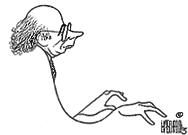
Here is contact information from Dick Hyman's website (and see the beautiful Al Hirschfeld caricature):


Dick Hyman Music, Inc.
617 Menendez Street
Venice, FL 34285

Phone: 941-485-9506
FAX: 941-488-1824

Email: dickhymanmusic@verizon.net
Al Hirschfeld drawing

Tuesday, December 2, 2014

Pauline Tish, dancer and teacher


Pauline Tish was the wonderful dance teacher at Pratt Institute during my years there from 1957 to 1961, a time when dance was not then part of the curriculum there, but which very much embodied the very essence of one's experience at an art school during my four years at Pratt.

When I first arrived at Pratt in 1957, coming by subway from the Atlantic Avenue Station of the Long Island Railroad on  Flatbush Avenue, I was a bit stupefied by the sheer number and ambitiousness of the courses presented to the incoming freshmen. On hearing about a dance workshop available as an excurricular activity, I leapt at the opportunity to do something freeing from the rather alarming challenge of the art classes. I felt it was going to be something pleasurable, and was not disappointed.

The classes were held on the stage of Pratt's theatre, Memorial Hall and began with us all lying on the floor, moving to the soft beats of a drum Pauline carried around the stage. A small and emphatic figure in black leotard and long skirt, she took us through floor exercise and stretches, followed by vigorous movement on our feet. But what to me was so intriguing was her explaining that ultimately each of us could arrive at creating our own choreography using whatever germ of interest that inspired us, which seemed to me something quite akin to the course of study in the visual arts, but bringing all aspects of experience into one focus: the visual, the three-dimensional, the elements of movement and music, and a chance to communicate with a present audience on a lit stage, in the mysteriousness of a darkened theatre. She, of course, oversaw the choreographical explorations, guiding, in a respectful way, one's own inclinations, and honing the result to something one could be proud of. Yet there was no forcing of her point of view on us, the initiates, more a mood of suggestion to make a professional result. To me, it seemed to surpass the visual arts efforts one was undergoing as a student, allowing a wider, freer kind of expression to happen. Hence, I enjoyed it hugely!

I regret that I cannot right now find some wonderful photos taken by a photographer who came to those Dance Workshop performances during the years I was at Pratt...I know I have them here somewhere, carefully tucked away, and shall keep searching for them, but they do attest to Pauline's both democratic and mentoring leadership of our efforts. Once I find them, I will post them here. And anyone else who was involved in these experiences will enjoy seeing the evidence of her excellent and subtle guidance, and the resulting good effects.


This below was written about Pauline in the Jewish Women's Archive:


Pauline Tish was professor emeritus and former chair of the Dance Department of Pratt Institute. Trained as a dancer with Martha Graham and Louis Horst, Tish performed with Helen Tamiris during the WPA Dance Project and was instrumental in the reconstruction of Tamiris’s How Long Brethren? performed at George Mason University in 1991 and the American Dance Festival in 1993 and 1995. Tish received a B.A. from Hunter College and an M.A. in dance from New York University, where she also pursued graduate studies in anthropology.

Pauline Tish passed away on April 1, 2002.


~~~~~~~~~~~~~~~~~~~~~~~~~~~~~~~~


Here is an excerpt from Pauline's article about choreographer Helen Tamiris, which also appeared in the Jewish Women's Archive:


"Helen Tamiris was a pioneer of American modern dance. She brought a social consciousness to the concert hall and went on to become the director of the Dance Project for the Works Progress Administration (WPA) and later an acclaimed Broadway choreographer. Her works were uniquely American, dramatically depicting important social issues of the time such as racism, poverty, and war. In 1928, she wrote the following manifesto in her concert program: “Art is international but the artist is a product of a nationality. … There are no general rules. Each original work of art creates its own code.”


She was born Helen Becker on April 23, 1902, into a poor but cultured Orthodox family on New York City’s Lower East Side. Her parents, tailor Isor and Rose (Simonov) Becker, had come with their son Maurice to New York in 1892 from Nizhni Novgorod, Russia, where they had fled from pogroms and czarist military oppression. Maurice Becker became a cartoonist and painter. Two other brothers were born in New York: sculptor Samuel Becker and art collector Peter Becker.


She attended New York public schools and later studied economics and labor statistics at the Rand School (1918–1920). At age eight, she began to study Isadora Duncan–style dance at the Henry Street Settlement, and at age fifteen her professional dance career began when she auditioned for the Metropolitan Opera Company Ballet. She danced for three seasons at the Met, toured with the Bracale Opera Company as a ballerina, and performed in the Music Box Review in 1924. Early in her career she took the name of Tamiris, a ruthless amazonian queen of Persia who overcame all obstacles.


In 1927, she presented her first solos in a concert called Dance Moods at the Little Theater in New York. The following year, a new concert at the same theater attracted excellent notices, and she was described as being in the forefront of the younger dancers of the “new dance.” This concert included Prize Fight Studies and the seminal and dramatic Negro Spirituals. Later in 1928, Tamiris became the first American dancer since Isadora Duncan to tour Europe, where the critics hailed her as the outstanding interpreter of American life. In 1929, she founded the School of American Dance and her company, Tamiris and Her Group, which she directed until 1945. From 1930 to 1932, Tamiris banded together with Martha Graham, Doris Humphrey, and Charles Weidman to found and direct the Dance Repertory Theater, a cooperative in which the four companies shared productions and expenses.


During the WPA, Tamiris became a spokesperson for American modern dance. In 1935, she went to Washington, D.C., as the head of the American Dance Association to lobby for the inclusion of a separate Dance Project in the organization of the Federal Theater Project under the WPA. The Federal Theater Project operated from 1935 to 1939, and Tamiris became the director and main choreographer of its Dance Project. She also acted as the organization’s representative in Washington. Her major productions during this period were Salut au Monde (1936), How Long Brethren?(1937), Trojan Incident (1938), and Adelante (1939). She continued to perform Negro Spirituals, which contained strong elements of protest against prejudice, violence, and human suffering, and could be considered a metaphor for Jewish oppression. From 1935 to 1945, Tamiris created many modern dance works.


As she began to perform less, Tamiris moved into musical theater. She had taught movement for actors and directors and was skilled at moving large groups effectively in her own dance works. She began to create and perform musical theater material with her partner Daniel Nagrin, whom she married on September 3, 1946. She went on to choreograph over eighteen Broadway musicals with Nagrin as her assistant. These included Up in Central Park (1945), Annie Get Your Gun (1946), Touch and Go(1950), Plain and Fancy (1955), and Fanny (1955). Outstanding dancers who performed for Tamiris in these shows were Daniel Nagrin, Talley Beatty, Valerie Bettis, Dorothy Bird,  Pearl Lang and Pearl Primus."


~~~~~~~~~~~~~~~~~~~~~~~~~~~~~~~~

When it came to the music for one's imagined dance-creation, Pauline would send us over to Manhattan to the famed Liberty Music shop, a place where, long before there were computers or cassette players or any online way of hearing music, you were able to select albums to listen to in one of the their listening booths, where you could hear all the bands on a particular album, and once something felt right for your "dance", you could buy the album, and bring it back in to Pauline, and she and you together would determine the exact right music for the dance-to-be. I remember one creation in particular: another student and I, Dorothy Connor, wanted to do something together that was based on "Degas" and "Toulouse Lautrec", and so we proposed our idea to Pauline and proceeded to first secure the music. Pauline sent us to Liberty Music for listening...I had already found a Chopin piece that I had on an album at home, played by wonderful pianist William Kappell, and that would be the Degas portion of the dance. But for the Lautrec, we went to Liberty and at Pauline's excellent suggestion, listened to a Francis Poulenc album and found the perfect musical equivalent of a Lautrec painting, a contrast to the quiet peacefulness of the Chopin. The missing photos are black & white, not color, the color being reds and blacks and Siamese pinks of a Lautrec painting, but the photos taken by Pratt's excellent photographer very much captured the spirit of the piece, the choreography, and the costumes.

~~~~~~~~~~~~~~~~~~~~~~~~~~~~~~~~

This picture is one I found online, it is Pauline taken at a family wedding...the picture is a little blurry, but very much the way I remember her!


Monday, September 1, 2014

Milton Feher & other innovative people

This is a story about people whose innovations have to do with walking on the earth with optimum comfort and ease. The first such person I would like to tell about is Milton Feher, but there are others as well: Sophia Delza, Pauline Tish, Patricia Norris and Harold Pessirilo. I want to write about these folks in future posts, and also to quote something interesting and pertinent from C. G. Jung's introduction to the I Ching, a book which I love.

Meanwhile, here is Milton Feher:

Milton Feher School of Dance and Relaxation

I first came to know Milton in 1962 when my left knee developed arthritis in an almost-overnight fashion. I had been taking a course at what in those years was a well-known business school in New York City: Speedwriting Institute on West 42nd Street, next to a popular store in those years, Stern's, right across from Bryant Park. Though I had graduated from an excellent art school, Pratt Institute, I was still in a dreamy state about what my vocation should be apropos of art: I wanted to paint, I wanted to write, and I wanted some employment, but the first two options didn't meet logically with the third. As I was not too practical in those years (something still to be worked on), I acquiesced quickly when my father suggested that I learn to type (and in my case, learn Speedwriting, a form of shorthand which uses the alphabet as opposed to symbols. My aunt Connie used to marvel at the ads on the subways in those years: "if u kn red ths".) My parents lived through the Depression, both holding jobs which were stable but many of their friends and siblings struggled to find and hold onto jobs. So I learned to type fast (the touch system) and to take dictation, which was how much of the business world progressed in the pre-computer world.  And as it happens, I still use my Speedwriting and recently found it marvelously helpful in doing a series of transcriptions for two PBS science series: "Brains on Trial" and "The Human Spark."

I started the Speedwriting course in the fall of 1961 following my graduation from Pratt, in what was to be an exceedingly cold winter in New York. The day the arthritis began was really bitter, and as I exited down the very long staircase at the school to head to Penn Station, I felt as though something had wrapped around my knee and was tightening on it nastily. When I got down to street level, I found there was nothing there around my knee causing the pain, and I made my way home with difficulty, thinking the pain was due to the intense cold outside. The next day, I visited my doctor, he did an X-ray, diagnosed arthritis, and gave me a cortisone shot in the knee. And after a short leave of absence from the school, I  decided to read up on rehabilitating a sore joint, finding in the phone book a unique listing under the categories of schools of dance: the Milton Feher School of Dance and Relaxation. It sounded wonderful, and then it actually was!

Milton was a very unusual teacher, not simply from the dancing standpoint, but he had evolved a unique way of overcoming his own arthritis which made his classes so special. Following are excerpts from his own writing and articles about him. I continued (with benefit to my knees) until I married and moved to Westchester, and returned to the classes when I moved back to New York with my two daughters, finding great benefit again, not only physical improvement but much that made sense to me in other realms. Eventually I began to write things in response to expressions Milton used to get people to free their bodies from stress and its resultant strain on the posture, the kind of posture he felt was everyone's birthright. He was pleased with the first poem-of-sorts I gave him, asked me to read it to the class, and I wrote more, reflecting back to him the words and freeing phrases he would say as we moved about the room.


Here is the first of the poetry-inclined writings...


Milton wrote an article for Prevention Magazine in 1958 which he later issued in a booklet:  "The Art of Walking: Walk Correctly for health, voice, sports, and figure". In it, he explains he'd been a dancer who'd developed arthritis in his knees, leading him to find his own unique solution to the problem. He was told by an orthopedist that the cartilage in the knees had been destroyed by excessive jumping, and that he would never be able to dance again.


From the booklet:  "I was a sorrowful ex-dancer as I hobbled miserably in Times Square one day, thinking of that wonderful dancing method which I would never be able to use. Almost unconsciously I made the corrections in my posture necessary to get the spine straight. Suddenly my body grew light and all the pain went out of my knees. Eureka! It was too good to be true! Straightening without strain, my body relaxed and the tight muscles causing the pain ceased to be tight. The pain returned soon and it was several years before it went away permanently. During this time I had tens of thousands of experiences indicating that effortless straight posture relieved my pain while my usual posture or a stiff erect posture caused pain."

"The outstanding fault in walking is tipping the head and trunk from side to side. We all know that the shortest distance between two points is a straight line. If you tip from side to side while you are advancing from one point to another, you are walking two miles for every one you progress. The sideways motion helps drag the legs forward, but robs the legs of a part of their proper function. Legs which do not work completely gradually stiffen up so that they can help you even less. This forces you to use the trunk more and more as time goes by. In most cases, the older you are and/or the weaker you are, the more you heave from side to side." 

(The booklet is illustrated with drawings showing the body "resting on your feet which are directly beneath you."   And there are several photos of Milton that exemplify his resting posture.)


The New York Times, June 20, 1988:

POSTURE AND FITNESS LINKED IN FEHER METHOD

WITH age comes stiffness. It is one of the givens of life.
So when we encounter a 75-year-old man who is as limber as the proverbial wet noodle, that's reason enough to pay attention. When he glides about his studio with the ease of a gazelle and stands interminably on one leg in a storklike pose, we listen to his words with rapt concentration. Never mind that his theories at times seem to cross the line from physiological fact into a charming, convincing ether, the metaphysics of a half-century of experience.
With age comes wisdom, and we youngsters would do well to listen and learn.
Milton Feher, dance instructor, stretching expert, balance coach, posture guru, relaxation proponent, has a current and longtime student who is 96. She also glides effortlessly about the studio, belying her age.
Our subject, then, is posture, which our mothers nagged us about. Feher considers posture, or balance, the foundation of all that he teaches and believes. Great athletes begin with posture. Posture can improve a runner's gait and speed. Feher lunged across the studio floor to demonstrate a point.
''When your body is balanced, your mind is balanced,'' he said...
(To read the rest of this article, you can go to the New York Times archives, and enter the title: "Posture and Fitness Linked in Feher Method". One quote from it particularly sums up Milton's point of view, expressed in every class and everything he wrote or said:  "The more you press against the earth and it supports you, the more relaxed you become," he said. "Relaxation is everything. When you relax, you function better.")

The Walking Magazine, 1986:
An article titled "Feher and Cool" had Milton saying: "The body, if released from tension, will straighten--that's a part of good alignment."


New York Magazine, May 28, 1990:
Author Patricia Burstein said: "Feher leads his pupils through a three-part routine that begins with a mantra: 'Let your arms rest. Let your head and trunk sink down. Let your legs relax.' Melodic notes, instead of rock music pounding the brain, issue from a piano played by Russian emigre Fima Farberg as the group sways into rhythmic dance exercises."


There is a recording of Milton speaking and taking the listener through his methods of relaxation: "Relaxing Body and Mind", which was produced by Smithsonian Folkways in 1962. 
It can still be ordered from them online (Smithsonian Folkways, Catalog No. FW-06191.) It was originally an LP, but is now available on CD for $16.98. The several sections from the CD can also be found via digital download under their headings: Walking without Effort, Effortless Good Posture, Going to Sleep, Breathing without Effort, Relaxing Body and Mind, The Habit of Relaxing, and How to Sit Correctly.


http://www.folkways.si.edu/milton-feher/relaxation-record/psychology-health/album/Smithsonian


A drawing I'd done at one of the classes...Milton was a fatherly figure to all his students...this must have been around 1990, and the two he is pictured with were Annette on the left, and Ursula on the right


And several more things I'd written for Milton...


1990:

The mind and what it is
was the question asked.
We sat on the floor like
crickets, with our bent
legs, and antennae poised.
I made myself not think
and an image of whiteness,
like stretched walls of a
tent, came to mind. I
felt the boards of the floor
were white too and stretched
far away and that what
was called the mind, the
alertness, was a bouncing
back and forth from the
farthest horizon and the
upright body that was me
with my small brain coiled
at the top like a fern-head. 


1998:

We stand on the point where the foot meets the earth

the body has been held clenched by necessity
and is surprised by freedom as the muscles let go
and let the earth walk the limbs

a river of restfulness flows upward from foot’s
contact with ground, the body poised and lightly straight
as a feather


I have more information to impart about Milton and his wife Marga, who worked with him for years. In one of the last classes I attended, a visitor came to the class, an old friend of Milton's who with him,  appeared at the 1939 Worlds' Fair in Queens as part of a ballet contingent in a production called "Railroads on Parade", music by Kurt Weill, written by Edward Hungerford, and sponsored by all the country's many railroads.  I  have some information to post about this unique event. Milton told us of "dancing" on bicycles as part of the World's Fair performances. And it so happens that my mother and father, Dorothy and Leighton, were at that very Fair the day before I was born, walking and enjoying all, maybe even having seen Milton on the stage that day. In later years, my mother and sister Cynthia began coming in to New York for his classes...Mom would have been in her 80s at the time, like so many of his students.

Here is one of Milton's repeated and inspiring utterances: (among many other similar wordy inventions):     " Let your head rest upon your toes, let your neck rest upon your heels"...
this said as we walked around and around the room in a circle, the way every class ended...
you can try saying it to yourself when you take a walk...the words keeping time with your feet.


Tuesday, August 12, 2014

The Little World of the Balcony...

I've been at a disadvantage for some months, trying to grapple with an aging computer which itself was grappling with the surge of change in computerdom. So now am in possession of a new computer, and looking forward to the pleasures of the blog again.

During this previous extremely snowy winter, I had a large ochre-colored flowerpot, of curving and commodious size and shape, which I foolishly, unknowingly, left out on my balcony to winter over. In spring I found a sad change had overcome it:  the entire glaze on the bottom of the pot must have been shocked from the repeated layers of ice on the balcony, and when I picked up the poor pot, I found it had discarded its entire glaze from the bottom half, which now lay like discarded snowflakes in the plastic pot underneath it.

Here follow pictures that illustrate the damage and yet the enduringness...

First, a similar flower pot (but in avocado green) which will show you the grace and nice size of the pot.

Next, the pot as it is now: the top half still ochre, the bottom, raw terra cotta, but still quite nice, reminding me of a zen pot. The next photo is a small moss garden that manifested when winter was waning: it possessed a mat of moss, a tiny bird feather, and a curled up leaf.

The third picture is the plastic pot I had nested the ochre pot in out on the balcony, where you will be able to see at the bottom the myriad little squarish pieces of the glaze making yet another kind of aesthetic pattern.

I like the word "enduringness", as, before this transformation,  the ochre pot, like its avocado brother, was always inside and comfortable, cozy as if before a hearth. Its maintaining itself, the roundness and sturdiness, sans the "slip", the glaze of golden color, shows a kind of innate courage in that which wishes to endure.

Here are the photos: first, the pots, then some other denizens of the balcony...


Friday, February 21, 2014

One NYC plant = 30 plants in Connecticut

Many years ago before moving here to Branford, I used to take a wonderful class in New York City with a special teacher, Milton Feher. I will post some information later on about Milton and his ideas about dancing for health and relaxation, but first, his studio and home were at 200 West 58th Street, and as I came and went to classes, I would walk right by the Horticultural Society of New York. Their ground floor windows were filled with an array of plants, and inside the door was a shop with plants for sale that they raised in their own greenhouses. I started buying plants there and one in particular, a special kind of jade plant (or Crassula) was still thriving when I moved from New York here to Connecticut. (See some information below about the Horticultural Society, which has now moved from 58th Street in NYC to West 37th Street.)

I thought I lacked the green thumb completely back in New York. Every nice plant I had would eventually fade away. But once here in Connecticut with windows facing all directions, my luck changed...the more copious sunlight via windows on several sides of my apartment was much to the betterment of plants.

The "mother" plant from the Horticultural Society shop gradually grew very large and ungainly and I had to re-pot it several times, the stems becoming so attenuated it seemed destined for the compost heap. So I had to do some "surgery" on it, hating to do so, and placing the cut-off stems into water, putting some of them away from light, and others right in a sunny windowsill (ever experimenting.) And to my pleasure, I would gradually find tiny frail threads of roots coming from the bottoms of the stems. These were the beginning of many of the plants I have now. Using cactus potting soil, I plant the root-festooned stems in small pots, and after a period of time, each become the little brothers of the original cactus from the Horticultural Society. (See photos below showing the stub of a truncated "trunk", and then the resulting little bouquet of new baby leaves at the top.)

If a particular plant's stems have grown so tall that the "trunk" cannot sustain the stem vertically and you find yourself propping them up with chopsticks and such, just cut about halfway down (or even lower on the stem) and place the long bits into water, keeping the "truncated" part happily in the sun, and watered. But I only water cactuses (cacti?) once a week, giving them then a generous lot of water. The newly-cut trunk will lack leaves for a while but is far from over on its quest to proceed with life. In due course, you will find tiny little green leaves emerging from the top of the trunk. And the trunk will have gotten thicker over time, benefiting from the removal of the long leaf-filled stem, and then will look lovely with its little garden of leaves emerging.


My mother had nice house plants. Dad took care of anything growing outside in the yard, and Mom took care of the indoor plants. She told me she had been advised over the years never to water a plant just a little bit, as the water won't get down to the roots. Rather, wait till the pot and soil is well dried out, and then give it as much water as it will hold. (I have a water filter faucet next to my kitchen sink and like to mix that filtered water (which is cool, not icy cold) with some warm water from the regular tap...that gives them something like room temperature water, rather than cold...I think they are much like ourselves, wanting to feel comfortable and "unsurprised" by events.) I usually go around each pot in circles putting the water with a long watering can spout just under the leaves and going around and around slowly so the water seeps down into the dirt. Mom said they much prefer lots of water once a week, rather than little bits every couple of days, so I adhere to that.

Pictures follow, including one big photo of the small guys lined up next to the original New York City Crassula at the left:


The Horticultural Society of New York, 148 West 37th Street, 13th Floor
 (They have periodic exhibits of art by a group of wonderful botanical artists.)

From their website  http://thehort.org/ :

The Horticultural Society of New York was founded in 1900, and incorporated in 1902, with J. P. Morgan, Louis C. Tiffany, and J.J. Phelps among its earliest members, the goal of the Horticultural Society was to further the love and knowledge of horticulture through informative monthly meetings, formal lectures and seasonal flower shows.

Today, over 100 years later, we are still growing a community of urban gardeners. Our development reflects the changes in urban horticulture itself, from a focus on specimen plants and ornamental gardens viewed alone in their majestic beauty, to a holistic understanding that plants and gardens are inexorably linked to the health of people, wildlife and our environment.

At The Hort, we recognize the interrelatedness and complexity of the “green” issues in our city, and therefore the core of our efforts is to educate and inform across the spectrum. We still help New Yorkers know plants and gardens as aesthetic wonders, but now our programs and projects encompass urban farming, rooftop gardening, container vegetable production, bioremediation, storm water abatement, landscape design, vocational training, horticultural therapy and environmental literacy.


I will also be posting information up ahead about Milton Feher.


Friday, February 14, 2014

Adventure Magazine Revisited...

I've been wanting to go back to the subject of my Aunt Connie working for Adventure magazine back in the early 1930s. That post was titled My Aunt Connie and Adventure Magazine. There are some more bits of memorabilia in the form of letters and things Connie had saved that I want to add here shortly, but first, a nice comment made on the post back in September:

Walker Martin said on September 24, 2013:

I've been collecting and reading Adventure magazine for 40 years and I hope you will continue to write about your aunt. 

I loved the memo concerning lateness at the office. Reminds me of my years as a manager. I must have sent a hundred memos warning employees. I was amused to see that Adventure had the same problem.

At the time, I wanted to email a response to Mr. Martin but didn't have his email address. I searched online and found he'd given the keynote address at a yearly event  in Columbus, Ohio called "Pulp Fest", his report on the convention appearing in a blog called Mystery*File, written by Steve Lewis.

Here's Steve Lewis's Mystery*File link:   www.mysteryfile.com

I contacted Steve to ask for Walker Martin's address, and told him that I had a great love of mysteries myself and would send him a list of my own favorites, honed over years of reading on trains and buses and in the wee hours of the night. I explained that I was fussy about the ones I read, in that I didn't like the Scandinavian ones of disturbing content yet also didn't  like the too-ordinary cozies either, only those with wonderful good writing and settings.
.
He gave me Walker's email address and replied, about the nature of mysteries:

I think I'm solidly with you as to mystery reading: I don't like excessive violence either, nor the present crop of cozies, which are far too bland for me.  Something in between would be good, but there doesn't seem to be nearly enough of those!

So I have just sent both Steve and Walker this list of my own favorite mystery writers:

Deborah Crombie              Water Like a Stone 
Philip R. Craig                    A  Deadly Vineyard Holiday
Barbara Hamilton               The Ninth Daughter
Jonathan Gash                    A Rag, a Bone, and a Hank of Hair
Susan Elia Macneal            Mr. Churchill's Secretary
Donna Leon                      Through a Glass Darkly
Earlene Fowler                  Mariner's Compass
Rhys Bowen                     Hush Now, Don't You Cry 
Margaret Maron               Bootlegger's Daughter
Susan Wittig Albert           The Darling Dahlias and the Naked Ladies
Iain Pears                         The Bernini Bust
Sue Henry                        The Refuge
Victoria Thompson           Murder on Bank Street
Martha Grimes                 The Old Fox Deceiv'd
Simon Brett                      The Witness at the Wedding
Alan Bradley                    The Sweetness at the Bottom of the Pie
Catriona McPherson         Dandy Gilver & an Unsuitable Day for a Murder 
J. F. Englert                      A Dog About Town
Mignon F. Ballard             Miss Dimple Disappears
Linda Greenlaw                Fisherman's Bend
Virginia Rich                     The Nantucket Diet Murders
Nancy Atherton                Aunt Dimity and the Deep Blue Sea
J. J. Fiechter                     Death By Publication


Here also are a few notes about my "favorites":


They all have as a great asset, a most important feature: a true atmosphere bespeaking a particular and interesting geographic area. In the case of the English and Scottish ones, as one who has not in fact traveled to any great extent, I somehow feel I have done so by virtue of my frequent virtual trips via wonderful mysteries.


The books by Catriona McPherson, Alan Bradley, Jonathan Nash, Susan Elia Macneal, Deborah Crombie, Nancy Atherton, Iain Pears, Martha Grimes, Simon Brett, and J. J. Fiechter are all set in the British Isles, though not necessarily all are American writers. Donna Leon's collection of books are all set in Venice. I love the Lovejoy books by Jonathan Nash, have old copies of them which I reread from time to time...they have the added blessing of tons of information about antiques and the aliveness of them, as Lovejoy perceives them, with whole pages of fascinating information about how to forge a magnficent painting (making the pigments oneself!), how to create a silver tray by hammering designs into it, how to forge a pearl! One of Donna Leon's goes into the process of glass blowing on Murano. Alan Bradley's main character, Flavia De Luce, is a child prodigy who has great knowledge of chemicals and forensics, so to speak. I really love all the books from these authors...


In the other bunch, the settings include: the south coastal ranch region of California (Earlene Fowler), Martha's Vineyard (Philip R. Craig), 1930s Alabama, a woman's garden club in a tiny town (Susan Wittig Albert), Boston, the exciting time preceding the Revolutionary war (Barbara Hamilton), 1905 in New York City (Rhys Bowen), North Carolina (Margaret Maron), both Hawaii and Alaska (Sue Henry), New York City, the era when Teddy Roosevelt was Governor of New York in 1900 (Victoria Thompson), Greenwich Village and other bits of New York (J. F. Englert), 1942, WWII, Elderberry, Georgia (Mignon Ballard), Maine and the world of commercial fishermen (Linda Greenlaw), and finally, this last one, written in 1985, "The Nantucket Diet Murders", a pleasure to read (Virginia Rich...of whom Down East magazine says: "Virginia Rich has established herself as the undisputed queen of culinary crime.")


A final word about Rhys Bowen. She is Welsh and has several series, each quite different from the others. The Molly Murphy ones include Hush Now, Don't You Cry; then there are the Constable Evans ones set in Wales, and the more recent series, Royal Spyness, which provide much great pleasure in reading about Lady Georgiana, who describes the terrible heat in London and riding the subway, and says: "You may be wondering whether members of the royal family frequently ride on the underground. The answer, of course, is no. My austere relatives King George V and Queen Mary would have only the vaguest idea of what the tube train was. Of course I am only thirty-fourth in line to the throne, and I am probably the only member of my family who was at that moment penniless and trying to survive on her own, in London..." (Note that among the many familiar and unfamiliar characters which appear in these books include the Duke and Duchess of Windsor during the years when they were extremely controversial.) These are very enjoyable books!


Here is a photo of my "collection" arranged on an old harpsichord in the living room (it does not play, some strings are broken, but is lovely to look at, and a fitting housing for such nice books!)


More of my aunt Connie's "archives" will be coming here soon...

And also re: Adventure: here is an updated website address for the Adventure cover artist, Earl Mayan:

http://www.earlmayan99.com/

Earl Mayan was also an illustrator for Saturday Evening Post, was a writer, poet and painter, and taught for many years at New York's Art Students League. On the website is a fascinating page showing how he used himself (as well as his wife Jean) as model for many of the Adventure and Saturday Evening Post illustrations...you can view the photographs and then the subsequent illustrations.